Last updated: 10 May 2026
The word "chatbot" has become a catch-all for anything that involves automated conversation on a website. Pop-up windows with pre-written responses. Rule-based flows that ask you to press 1 for sales and 2 for lettings. FAQ widgets that answer the same five questions on a loop. All of these get described as AI. Most of them are not.
The distinction matters for estate agents because the two things — a basic chatbot and a genuine AI assistant — produce very different outcomes. One answers questions. The other progresses the enquiry. And in a market where the difference between a booked viewing and a cold lead often comes down to a single conversation, that distinction is significant.
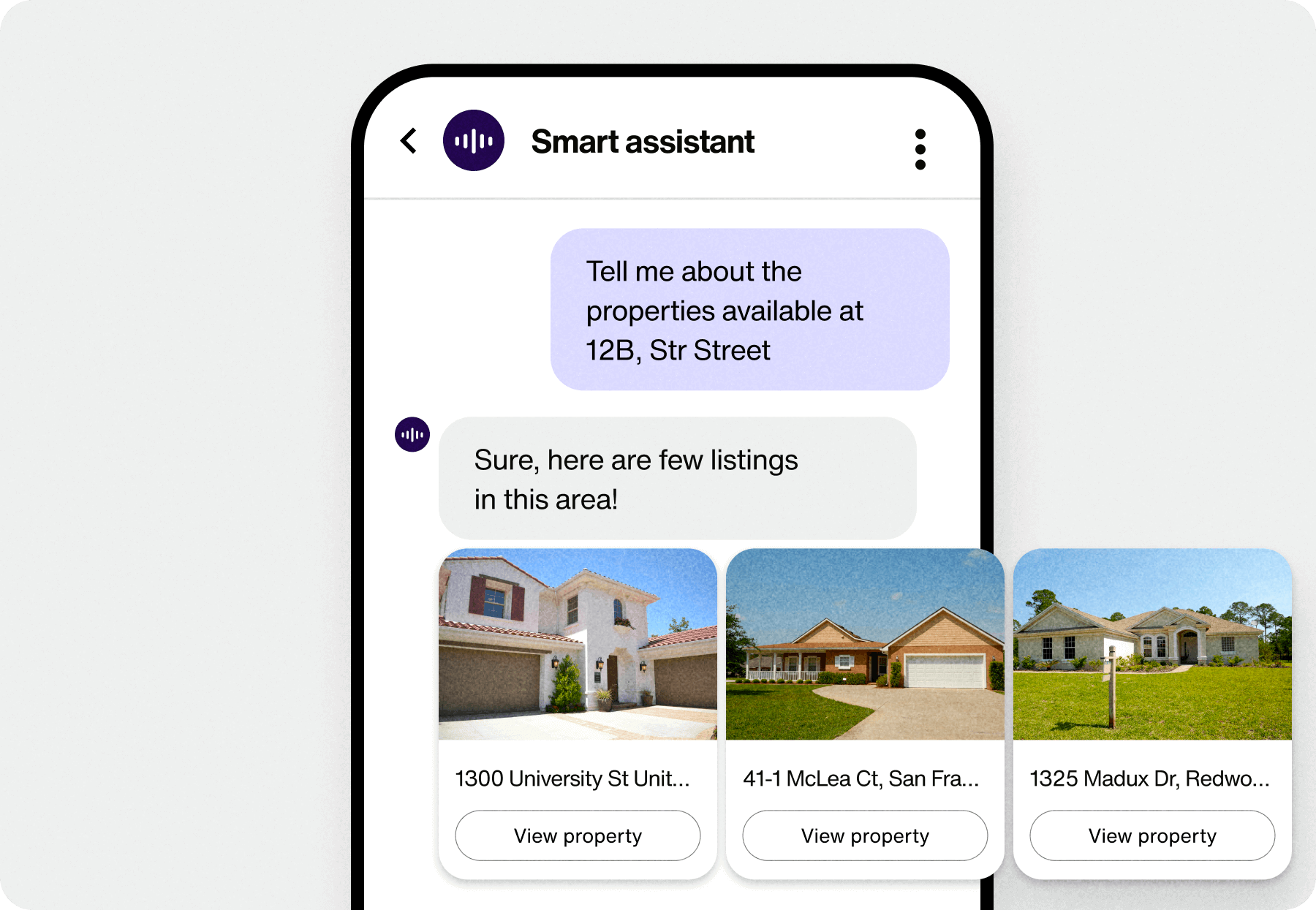
A genuine AI assistant does more than answer questions — it actively moves the enquiry forward.
What a Basic Chatbot Does
A basic chatbot operates on rules. It has a decision tree — a set of pre-written questions and responses that guide the conversation along a fixed path. If the visitor asks something outside that path, the chatbot either fails to respond helpfully or falls back to a generic message like "I'll pass this on to the team."
These tools have their uses. They can handle simple FAQ queries — opening hours, branch locations, basic process questions. They reduce the volume of repetitive enquiries that would otherwise reach the team. For that narrow purpose, they work reasonably well.
But they cannot do what a good negotiator does in a first call. They cannot understand a buyer's specific requirements and match them against the current stock. They cannot answer nuanced questions about a particular property. They cannot adapt the conversation based on what the buyer says. And they cannot move the conversation towards a booking.
What a Genuine AI Assistant Does
A genuine AI assistant — one built on a large language model with access to your property data — operates differently. It understands natural language. A buyer can describe what they are looking for in their own words: "I need something with a garden, close to good schools, ideally under £450,000, and I'd like to be in by September." The assistant understands the intent, not just the keywords, and responds accordingly.
More importantly, it does not just respond — it progresses. It asks the right follow-up questions. It presents matching properties with photographs and full details. It handles objections and answers specific questions about listings. And when the buyer is ready, it moves them towards a clear next step: a viewing, a call, or a registration.
See how Madison handles a real buyer conversation →
See the difference for yourself
Try Madison on the Prevou demo and see how a genuine AI assistant handles a property enquiry compared to a basic chatbot.
Try the Live Demo →The Qualification Problem
One of the most valuable things a first conversation does — whether with a negotiator or an AI assistant — is qualify the buyer. Are they in a position to proceed? Do they have a property to sell? Are they mortgage-ready? What is their actual timeline?
A basic chatbot cannot do this. It can collect contact details, but it cannot have the kind of conversation that reveals whether a lead is genuinely worth pursuing. The result is that the team spends time following up on enquiries that turn out to be early-stage browsers, while the serious buyers who needed an immediate response have already moved on.
A genuine AI assistant can qualify buyers naturally, within the conversation, without it feeling like an interrogation. By the time the lead reaches the team, there is context — what they are looking for, what their situation is, how ready they are to move. That makes every follow-up call more productive.
The 24/7 Dimension
There is one area where even the most basic chatbot has an advantage over a human team: availability. A rule-based chatbot can respond at 11pm on a Sunday. So can a genuine AI assistant — but with a crucial difference.
The basic chatbot responds at 11pm on a Sunday with a message that says "Thanks for your enquiry, someone will be in touch during office hours." The AI assistant responds at 11pm on a Sunday with a full conversation — property matching, question answering, viewing booking — that treats the buyer as if the office were open.
For estate agents, out-of-hours enquiries represent a significant share of total enquiry volume. Handling them with a holding message is better than nothing. Handling them with a genuine conversation is a different proposition entirely.
The Practical Implication
The practical implication for estate agents evaluating AI tools is straightforward: ask what the tool actually does with an enquiry. Does it answer questions, or does it progress them? Does it collect contact details, or does it qualify the buyer? Does it hand off to the team with a name and email, or with a full picture of what the buyer wants and how ready they are to move?
The answers to those questions will tell you whether you are looking at a chatbot or an AI assistant. And the difference, in terms of the leads you convert and the viewings you book, is not marginal.
Want to see what a genuine AI assistant looks like?
Book a 20-minute demo and see how Madison handles a real buyer enquiry from first message to booked viewing.
Book a Demo →